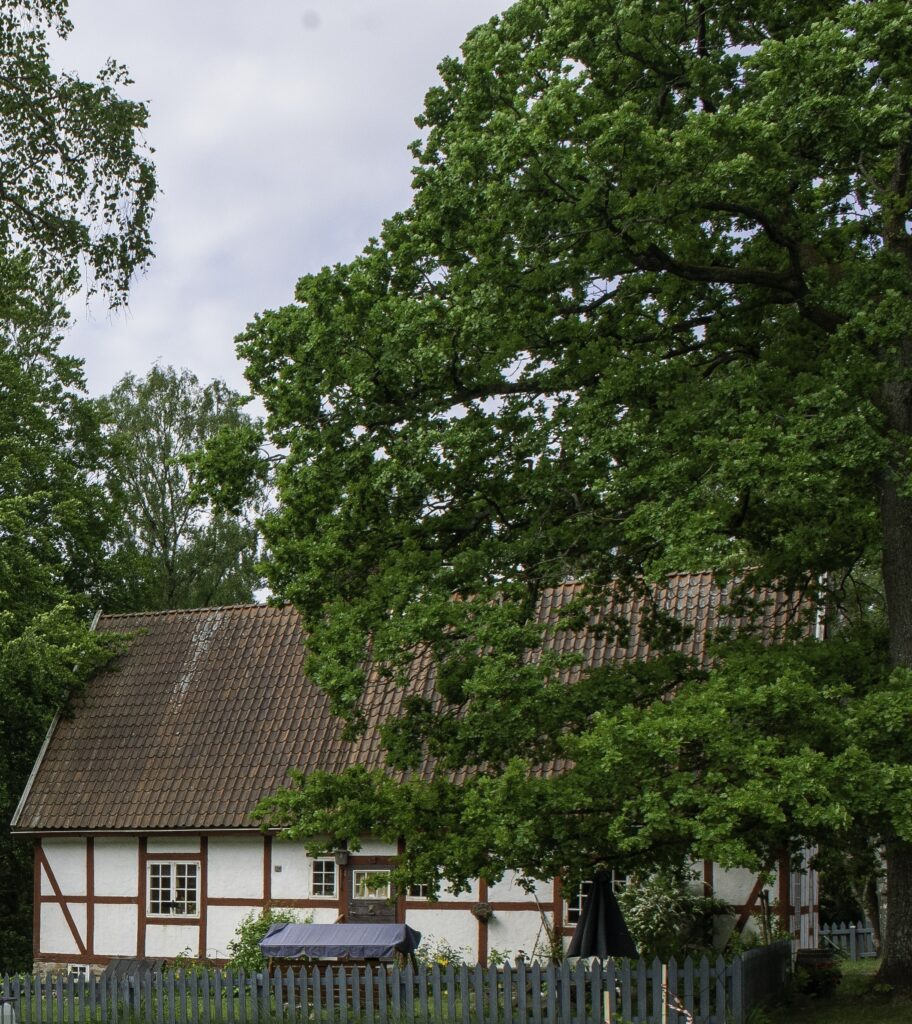
The School House
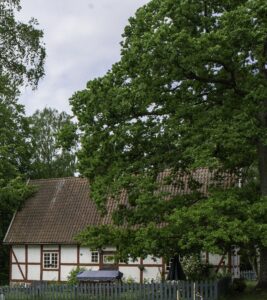
The school was built in 1843 in Eldsberga, outside Halmstad. It was relocated to Hallandsgården in 1943.
It is a half-timber house, and originally had a thatched roof, which with time was exchanged for bricks. Above the entrance is an oak plank where it says Eldsberga parish school 1843.
The school was built the year after Sweden issued the first law on public elementary education. It stipulated that there should be at least one school with a professional teacher in every parish.
Eldsberga parish was part of Stjärnarp mansion, which at that time was owned by counselor Anders Jöran Hammar. He believed that Eldsberga needed its own school and paid all expenses for building it. As a return he got to choose who would be the school´s first teacher. He also supplied the school with firewood, summer- and wintergrazing for the teacher´s cow as well as a vegetable garden.
The classroom measures 9×6 meters and the teacher´s apartment was two rooms and a kitchen. In the classroom one can see the teacher´s podium, and on it an inkstand with a feather quill pen. There are long benches without backrest, of which one has a socket for an inkstand. In the front of the room is a bench with a sandbox, where the younger children could practise writing. There is also a chalkboard with crayons and a paw of a hare as an eraser, as well as several smaller slates, an abacus, different tables and books.
When the school was new the education system used was the English monotorial system, also known as the Lancasterian system. The children were not divided in classes by age, but instead in groups according to their learning pace. Children who were a little bit ahead were chosen to help teaching their younger classmates.
The education consisted of, among other subjects, religion, handwriting, mathematics, natural science, geography, Swedish history, gardening and gymnastics. For boys the gymnastics classes could include military and weapon exercises. This was to make it easier for the farmers by not having to send their sons away early on military service, when they were needed on the farm. Girls were not considered to need the same skills in mathematics as boys, but on the other hand they supposedly needed household schooling, such as sloyd or handicraft. The girls of Eldsberga school had two hours of sloyd a day, in classes led by the teacher´s wife.
The school day was often long. It began at 9 am and finished at 5 pm. One pupil was appointed monitor and had to come before the rest to clean and put wood in the fireplace. There were lessons also on Saturdays, but only a half day. For a long time there was no compulsory school attendance, which meant that the children sometimes stayed at home to help on the farm, for example around harvest time. Another reason for not going to school could be that the child didn´t have shoes and that it was too far to walk to school barefooted.